 STRIPER TRACKER
 | FALL MIGRATION REPORT
TOWN OF THE WEEK: MONTAUK POINT, NEW YORK
Closing In on the Magic 58°F
Montauk Point is approaching one of the most interesting temperature milestones of the fall striped bass migration.
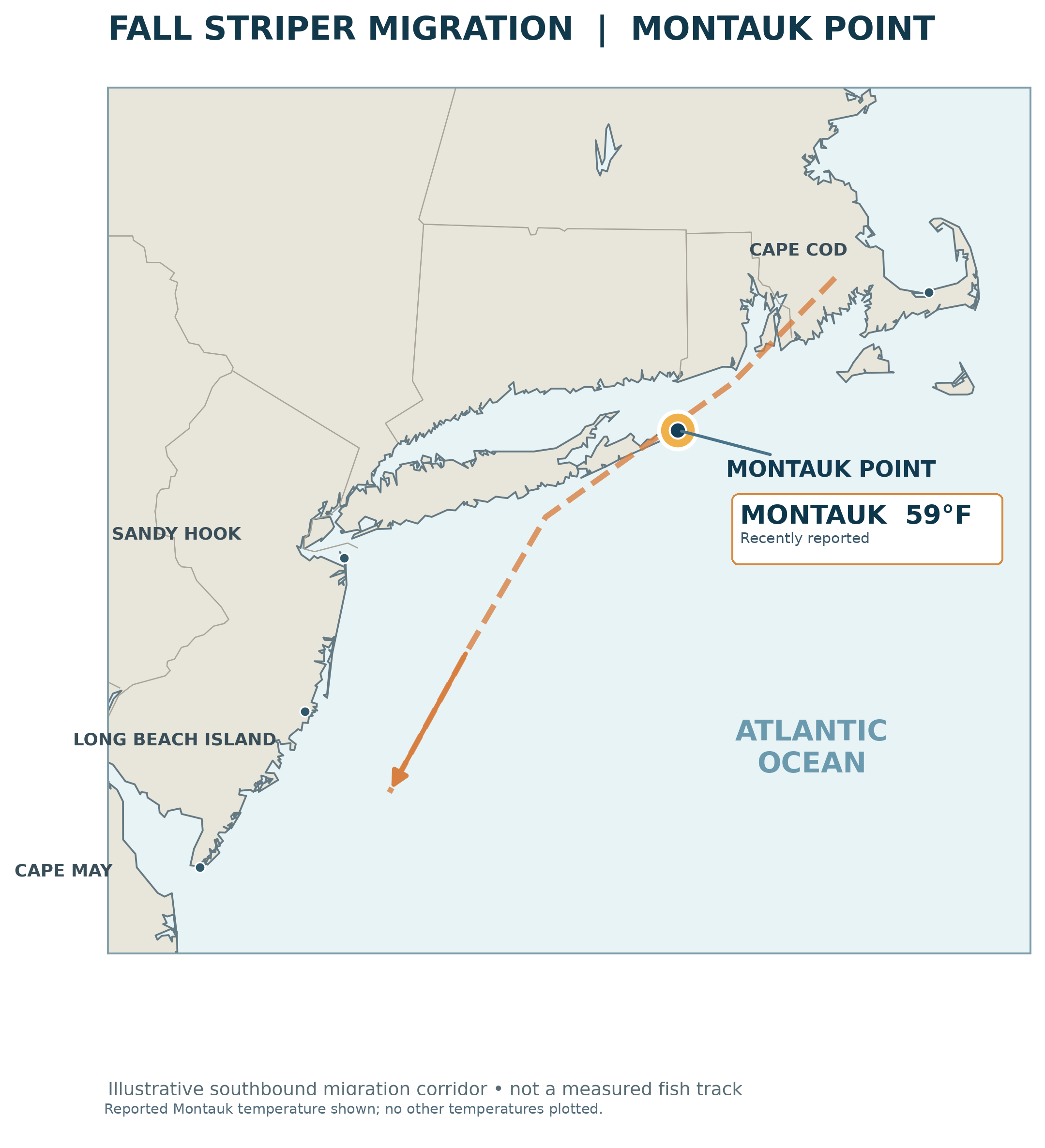
With a recently reported ocean water temperature of 59°F, Montauk is just one degree above Striper Tracker’s preferred 58°F fishing temperature—and already within the favorable 55–62°F feeding range identified by Dr. Adam Aguiar of Stockton University.
But what influences that final degree of cooling, and what does the historical record tell us?
We examined 14 years of historical NOAA water-temperature records at Montauk, from 2012 through 2025. The findings reveal just how unpredictable the cooling process can be.
🐟 What the Research Tells Us
- Montauk’s temperature: Recently reported at 59°F, just one degree above the preferred 58°F fall fishing temperature.
- Historical cooling range: The first daily-average crossing below 60°F to the first crossing below 58°F has taken anywhere from 0 to 22 days.
- The median: Approximately 5 days across the 14 seasons examined.
- Fastest transitions: In 2018, both temperature marks were crossed on October 22. In 2016 and 2020, the transition took just one day.
- Longest delays: In 2019, cooling between the two marks took 17 days. In 2024, it took 22 days.
- Temperature reversals: In October 2023, Montauk’s water temperature climbed from 59.8°F back to 62.5°F in just two days.
- What causes the differences? Sustained colder air encourages ocean cooling, while warmer weather, wind, currents, and the underwater geography around Montauk Point can influence how quickly temperatures change.
🐟 The Bottom Line for Fishermen
At 59°F, Montauk is already within an excellent temperature range for actively feeding striped bass.
Swimming plugs, bucktails, soft plastics, and surface plugs remain important parts of the fall surf fisherman’s arsenal when fish are feeding on migrating bait. If you’re new to the migration chase, try our 2026 Fall Run Attack Pack for three proven lure styles and tips on how to fish them.
Whether Montauk cools rapidly or experiences an extended period of favorable temperatures, the important lesson is that the progression of the fall run is influenced by much more than a single thermometer reading.
For fishermen from Cape Cod to Cape May, understanding these changing conditions can help explain why the migration sometimes moves quickly through an area and other times provides extended fishing opportunities.
Research and Data Sources
NOAA National Ocean Service: Montauk water-temperature station 8510560, historical observations, 2012–2025. Station is on the Fort Pond Bay side, not at the oceanfront surf.
Dr. Adam Aguiar, Stockton University: “Too Warm, Or Too Cold? Species’ Preferred Temperature Ranges,” The Fisherman, October 2023.
Oceanographic research: Lentz et al. (2010), Fewings et al. (2011), Chen et al. (2015), and Ilia et al. (2023), Journal of Geophysical Research: Oceans.
About Striper Tracker
Striper Tracker follows the spring and fall striped bass migrations along the Atlantic coast, combining ocean water temperatures, migration outlooks, tides, moon phases, wind, and daily local fishing conditions. New Fall Migration Reports are published every Tuesday and Friday.
© 2026 Striper Tracker. Reproduction permitted with attribution to Striper Tracker and inclusion of stripertracker.com.